the same beans different brews
Everything I've been handed — an idea, a product, a design, a strategy — I've worked roughly the same way. It's easiest to explain as coffee, so that's how I'll explain it.
-

01 Sourcing
The bag, still sealed
Every brief arrives sealed and pre-labelled. Someone has already decided what's inside and what it's for. I don't open it yet — I find out who's asking, what they'll do with it, and what they've already tried and abandoned. Half the time the ask is "we need a dashboard" and the problem is that nobody trusts the numbers.
With an idea, this is the part where I try hardest to kill it — if it survives a week of me looking for prior art, it might be real. On a product, it means reading support tickets and sales calls before reading the feature request. On a design, it means asking what the screen is competing with, not what it's supposed to contain. On a strategy, it means finding out which decision has already quietly been made.
-

02 Dosing
The portafilter, dosed
Then I cut it down until it fits the basket. One sentence: what is the single thing this must do. Everything that doesn't survive that sentence goes into a "later" list that I keep, and mostly never open. Overdose the basket and nothing extracts properly.
An idea gets one sentence and one user. If it needs two, it's two ideas. A product gets a v1 that would embarrass me slightly. That's usually the right size. A screen gets one job and one primary action. The rest earns its place or leaves. A strategy gets a single bet. Three priorities is a wish list, not a plan.
-
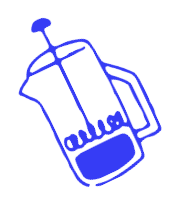
03 Steeping
The French press
Some problems want immersion and time. Research, reading, talking to the people who actually use the thing. No pressure applied, nothing forced — you leave it alone and it gets stronger on its own. This is the part clients think is slow. It's the part that makes the rest fast.
For an idea: read everything adjacent, then stop reading and go talk to five people. For a product: watch someone use the current version without helping them. For a design: collect fifty references before drawing one rectangle. For a strategy: find the numbers nobody has looked at in eighteen months.
-
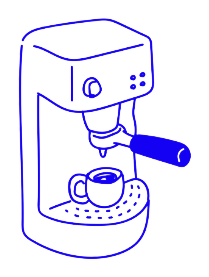
04 Pressure
The espresso machine
Some want the opposite: nine bars, thirty seconds, a machine that costs real money and demands you know what you're doing. This is the build — the spec, the team, the deadline. Expensive setup, unforgiving margins, and the only method where being two percent off is the whole difference.
Ideas rarely need this. If one does, it isn't an idea any more — it's a project. Ten developers, four country sites, one CMS. You do not improvise at this pressure. Design systems live here: tokens, states, edge cases, the boring parts that hold. Rollout lives here. A strategy nobody can execute on a Tuesday is a document.
-
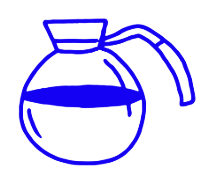
05 Volume
The carafe
And some have to serve a hundred people at once, consistently, all day. Systems, process, strategy. Nobody's tasting notes matter here; what matters is that the fiftieth cup is the same as the first. Designing for volume is a different craft to designing for one perfect shot, and confusing the two is how good work dies at rollout.
Ask early whether the idea gets better or worse when a thousand people use it. Onboarding, defaults, and empty states are the product at volume. A template that ten people can fill badly beats a masterpiece only I can make. Consistency beats brilliance once more than one team is involved.
-
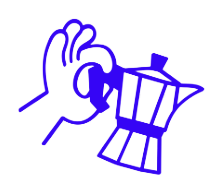
06 Improvising
The moka pot
Most of the time there's no machine. There's a stove, a moka pot, and a Tuesday. So I build it by hand — the prototype, the spreadsheet, the deck at 2am, the thing that shouldn't work but does. I'd rather ship a good stovetop version now than plan a perfect one for a machine we haven't bought.
The fastest way to test an idea is usually a landing page and an awkward DM. A convincing fake beats a real backend for the first two weeks. Ugly and clickable teaches you more than beautiful and static. Run the small version somewhere nobody's watching before you name it.
-
07 Tasting
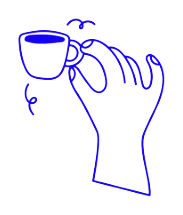
The cup, tasted
I taste my own shot before it goes out. Every time. I read the copy aloud, click through my own flow as a first-time user, run the numbers a second way. It's an unglamorous ten minutes and it catches most of what would otherwise be caught by the client, in public.
Pitch it to someone who has no reason to be nice, and watch where they drift. Use it as a stranger would: fresh account, no context, no shortcuts. Look at it at 50% zoom, on a bad screen, in daylight. Argue the opposite case properly. If it wins, the strategy was wrong.
-

08 Serving
The to-go cup
Then it gets packaged for the person carrying it, not for me. A doc someone can skim in a lift. A deck that survives being forwarded without me in the room. Handover is a design problem — most work doesn't fail at the making, it fails at the handing over.
One page. Problem, bet, what we'd need to believe. Release notes people actually read, and a changelog that admits things. Specs with the reasoning attached, so nobody has to guess a year from now. A version the team can repeat back to me correctly, without the deck.
-


09 What comes with it
The croissant, the danish
Nobody asks for these. I do them anyway: the illustration, the naming, the one extra slide that makes the argument land. It isn't scope creep — it's the difference between a coffee and somewhere you go for coffee.
A name and a drawing make an idea real enough to be argued with. The small delight is the thing people describe when they recommend it. The bit that has no ticket is usually the bit that gets remembered. A strategy with a good line in it travels further than one without.
Nine steps, one habit: find out what's actually being asked, cut it to what fits, pick the method on purpose, taste it before anyone else does.
The conventional version →